The Case for a Net Zero Energy School Building in Harrisonburg

A coalition of a number of local activist groups is on a mission.The Harrisonburg City Public School Board is in the planning phase for a new middle school to be located next to either the Harrisonburg High School or the present Thomas Harrison Middle School. It is the perfect time to consider designing a showcase net zero energy building (ZEB) which can function as a model and learning center for area students as well as offer significant energy and money savings benefiting our climate and taxpayers.
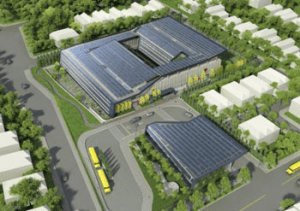
NZEB image
image from sustainablebusiness.com’s story on New York City’s first net zero energy school

CAAV is one of the members of the coalition, dubbed New Middle School LEED/ZEB Project. LEED stands for Leadership in Energy & Environmental Design, a program of the U.S. Green Building Council which offers nationally accepted certification for sustainable building. CAAV member Bishop Dansby says: “The City of Harrisonburg School Board is going to build a new middle school. The architect, Crabtree, Rohrbaugh and Associates Architects, has been chosen but the design has not been developed, yet. We are on a campaign to convince the school board to make the new middle school a net zero energy structure. This will mean that via the addition of about 500kw of solar panels, the school’s net energy use over the course of the year will be zero!”

“… schools are the best opportunity to build NZEB (net zero energy buildings). They have low energy density (50% commercial), have long holidays and summer where use decreases, and the ‘owner’ has a long investment horizon (to justify the investment in solar).

You can think of NZEB as LEED plus solar. Of course, you could have NZEB without LEED, since some of the aspects of LEED have little to do with operation energy cost. However, when LEED is combined with NZEB, you have the best we humans can do for sustainability at this point in time. Further, the school becomes a learning laboratory for school children, and this is the way these schools have been used in other states.

This would be the first NZEB school in Virginia, but there are several around the country.

Frankly, the proposed new Harrisonburg middle school is large. It is actually at least as large as the Lady Bird Johnson Middle School, in terms of number of students. I found out from the meeting last night  (School Board Meeting, 10/15/2013, see Architects Agenda)   that the estimate of 900 students is a low estimate. This will make this NZEB project even more outstanding: it is one thing to build a small NZEB, but even more interesting to build a large NZEB. This could mean the solar array could be even larger than 500 kw.

… the School Board has the option to buy the solar array outright or to enter a power purchase agreement (PPA). Today, for a system this size, solar will cost $3.00 per watt, for a total or $1.5M for a 500w system. If we want to put pressure on the School Board, we can make the case that it would be economically irresponsible to not at least enter into a PPA, as this would reduce their power cost by 10% with no investment. By the way, we have found no evidence that LEED cost more than conventional construction, but let me know if you know different.”

Formed by the Harrisonburg Rockingham Green Network, the coalition currently consists of the Climate Action Alliance of the Valley, the local Shenandoah Group of the Sierra Club, Valley 25 X ’25, The Voluntary Gas Tax, and local architect Charles Hendrick’s The Gaines Group, PLC. Becky Johnston of the Harrisonburg City Schools’ Safe Routes to School has also endorsed the effort. They will be “reaching out to actual users of the schools, that is, the parents of the children in the school district where it will be located (basically on the northwest side of town).”

Paul Hutton, AIA, LEED AP, founding Principal of Hutton Architecture Studio, in Denver, Colorado writes for the Council of Educational Facility Planners International: “One of the fastest growing trends in school design is Net Zero Energy Schools. There are now at least a dozen or more schools completed or in construction that have achieved, or have committed to, this incredible level of energy efficiency.”  Bishop recommends his article Zero Energy Schools – Beyond Platinum for an “excellent primer on the subject.”

LEED accredited architect Charles Hendricks of the Gaines Group writes about this project on his website, Design Matters: Why build a ZEB Middle School in Harrisonburg.

A Zero Energy Building solution shows the community that our leaders care about future costs to run a facility, tax burdens imposed on community members, and the health of our environment. More important, it shows that our community cares deeply for our children and their future.  – Architect Charles Hendricks
green school factsLearn more about the benefits and cost savings of LEED-certified schools from Ashley Katz of the U.S. Green Building Council here.

“LEED-certified schools provide students, teachers and visitors with clean and healthy air to breathe, better acoustics, regular access to daylight, thermal comfort and moisture control. LEED for Schools emphasizes strategies to create spaces that enhance learning …”

va beach sustainable schoolsBy way of example, Virginia Beach City Public Schools subscribe to a sustainability plan where, “Any new or renovated building will be designed to achieve a LEED (Leadership in Energy and Environmental Design) silver rating at a minimum.”
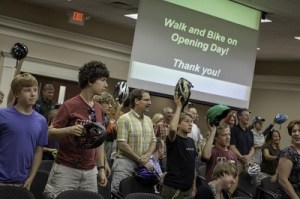
walk and bike on opening day
City Council meeting, March 28, 2013
photo from Becky Johnston

Earlier this year, the Harrisonburg City Public School Board’s request to the Harrisonburg City Council for the new school drew a packed audience interested in seeing that bicycle and pedestrian infrastructure be included in its planning and funding. See the Northend Greenway’s post about this here.

To further the coalition’s efforts to promote a net zero energy (and bike/ped accessible) Harrisonburg Middle School:

Journalist Emily Sharrer covered this project for the Daily News-Record on November 11, 2013, here.

Bishop Dansby’s Open Forum piece in the Daily News-Record on November 23, 2013, here: New School Should be Green.

New Middle School LEED/ZEB Project co-leaders Bishop Dansby and Jeffrey Tang offered comments about the new middle school design at the Harrisonburg City School Board meeting on Tuesday, November 5. Click on either image below for video of the meeting. School discussion begins at 44 minutes.
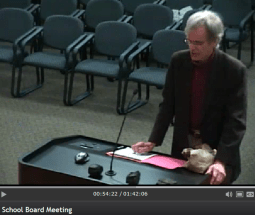
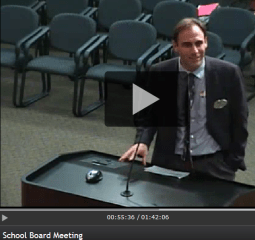
bish with coalJeff at Bd meeting

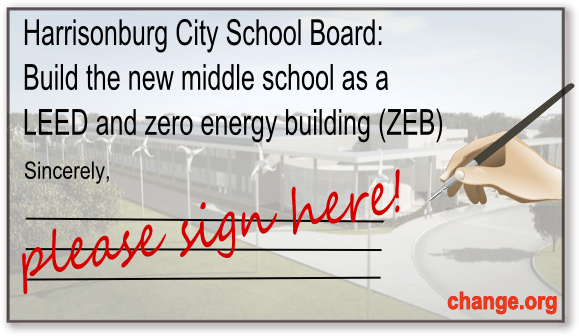
change.org school petition
Click on this image to sign the coalition’s online petition!

______________________________________________________________________

December 10, 2013 update from Tom Domonoske:

Dear All:

Last week Bishop and I went to a meeting at the School Board’s offices that we were told was with the architects. It turned out to be a meeting with the architects, the engineers, both mechanical and physical, school reps and a person from Chicago helping to organize the design process. They were very interested in the concepts and made clear that the limiting factor is how the City Council makes the money available. If, as in the past, the City Council provides a lump sum and says “build the best school you can with this money” then the money is hard to allocate to future energy savings beyond what the Building Code requires.

They repeatedly said that LEED certification at one level is almost a given because of Building Code requirements. That does not necessarily translate into energy efficiency or production because LEED points can be obtained in a number of different ways.

The real work is on City Council and the budget process. The issue is that savings from future budgets regarding lower utility payments are a totally different budget than capital improvements budget for putting up the building. We need the City to add the current value of the future savings into the dollars made available for the building. Then the School Board can spend money on energy efficiency.

I do not know when will be the best time to have a bunch of people attend a City Council meeting, but we need to figure that out and plan it. I am assuming it will be after a site is chosen in January but am really not sure.

Also, I have added Scott Kettelkamp to this list. He is local contractor who has built three passive solar townhomes in Harrisonburg that also have active solar panels. They include things like shades on light sensors that automatically open and lower, etc. He has data on how they have performed through the seasons that is Harrisonburg specific and his wife teaches elementary school in the City Schools and they have children in the school system. We need people like him to attend whatever meeting we will have in front of City Council to present their experience and what they want.

Finally, if you have not filled out the school’s survey, then please do so. Go to http://www.surveymonkey.com/s/HCPSCommunitySurvey

Thomas D. Domonoske
461 Lee Avenue
Harrisonburg, VA 22802
(540) 442-7706
Member, National Association of Consumer Advocates, www.naca.net

Win This Tree … PARKlet PROJECT

CAAV PARKlet 10.4.2013We Need Trees … Win This Tree!

CAAV promoted the benefits of trees and gave away a flowering cherry tree for downtown Harrisonburg’s PARKlet PROJECT Friday evening, October 4 from 5- 8pm.Thanks to Cathy Strickler for the idea and energy behind our spot. Planting trees remains one of the most cost-effective means of drawing excess CO2 from the atmosphere.

Congratulations to Charlotte whose name was drawn from the pot of 27 names to win the tree!

Thanks to Anne Nielsen for compiling these eight reasons to love trees:

8 Reasons to Plant a Tree

If you have ever been walking in the sun on a hot city street and then come into the cool shade of a big tree, then you probably intuitively know some of the benefits that trees offer. The following 8 reasons to plant a tree were gratefully adopted from The Urban Tree Book, by Art Plotnik.

1.   Trees produce oxygen. A mature leafy tree produces as much oxygen in a season as 10 people inhale in a year.

2.   Trees help to clean the air. Trees help cleanse the air by intercepting airborne particles, reducing heat, and absorbing air pollutants including carbon monoxide, sulfur dioxide, and nitrogen dioxide. Trees reduce and remove air pollution by lowering air temperature, through respiration, and by retaining particulates. Evergreen conifers, such as pine trees, produce slightly higher levels of nitrogen dioxide and therefore broadleaf trees, such oaks and maples, are recommended for maximum air quality benefit.

3.   Trees become “carbon sinks”:To produce its food, a tree absorbs and locks away carbon dioxide, a global warming gas. An urban forest is a carbon storage area that can lock up as much carbon as it absorbs, until the leaves (or the trees)  fall and rot.

4.   Trees shade and cool: Shade from trees reduces the need for air conditioning in summer. In winter, trees break the force of winter winds, lowering heating costs. Studies have shown that parts of cities without cooling shade from trees can literally be “heat islands,” with temperatures as much as 12 degrees Fahrenheit higher than surrounding areas.

5.  Trees act as windbreaks: During windy and cold seasons, trees act as windbreaks. A windbreak can lower home heating bills up to 30%. A reduction in wind can also reduce the drying effect on other vegetation behind the windbreak.

6.   Trees fight soil erosion: Trees fight soil erosion, conserve rainwater, and reduce water runoff and sediment deposit after storms.

7.    Trees make effective sound barriers: Trees muffle urban noise almost as effectively as stone walls. Trees, planted at strategic points in a neighborhood or around your house, can abate major noises from freeways and airports.

8.  Trees increase property values: Real estate values increase when trees beautify a property or neighborhood. Trees can increase the property value of your home by 15% or more. Planting a tree leaves a legacy that you and your children can visit as the years go by, reminiscing about how you used to be the same height, marveling as the tree grows, and basking in the coolness and shade on a hot summer day.

tree services

Thanks to Patti Nylander, Senior Area Forester, Virginia Department of Forestry, for our handouts “to help people take better care of their urban trees,” including 24 Ways to Kill a Tree.

More photos from the CAAV PARKlet PROJECT in this Picasa web album:

PARKlet PROJECT 10.4.2013

Put a Price on Carbon

This letter was available for signing at the CAAV booth at the International Festival in Harrisonburg on September 28, 2013.

Dear Senators Warner and Kaine:

Warner Kaine video all.of.the.aboveWe at Climate Alliance of the Valley have watched your recent YouTube video titled – Bill to Expand Offshore Energy Leases- and are responding to your invitation for citizen input.  Although this would not take effect until 2020, we feel it is misdirected in light of the science explaining the chemistry and physics of climate disruption.

This plan may have been justified when the former Senators Warner and Webb first introduced this but we are better informed now.  We know now that to help protect future Virginians it is imperative that we leave all fossil fuels deep in the earth and not put them in the atmosphere to cause excessive heating of our beautiful blue-green ball, with the only  known existence of life as we know it.

If you have read the science, and we feel both of you at least understand what is happening, there is no other choice than trying to get off of our fossil fuel addiction. You have both sponsored and supported some very important energy legislation. It is really difficult for the alcoholic not to take that next drink.  It is time now to take the next step. Put a Price on Carbon.

It is easy to understand where you are coming from politically in this video and we would like to see you re-elected unless someone else is more willing to step up and support legislation to preserve life as we know it.

If you have read the science and know the facts, how can you do other than step forward and put some kind of price on carbon.  What will your children or grandchildren say in 20-30 yrs if you don’t do what you can now?

We are supporting some form of Fee and Dividend (S-332, Saunders-Boxer Bill or several house bills etc). Citizens Climate Lobby has done a lot of work on this.  We feel it is the only kind of bill that has a chance of passing and will do the job of reducing our carbon usage.  We know all the arguments against this pushed by the fossil fuel industry and we know what is going to happen if we don’t soon get started.  Therefore, we are asking you both to become leaders in trying to stop us from destroying ourselves.

International Fest 2013

International Festival 2013.400CAAV invited Harrisonburg International Festival 2013 attendees to contribute stickers to our board listing things we do to reduce our carbon footprint. This September 28 event held at Hillandale Park attracted over 8000 people to enjoy an afternoon of music, dance, food, crafts and non-profit displays in celebration of “our community’s rich intercultural diversity.”

In addition to placing stickers on the carbon footprint board, we also invited signatures on a letter to Senators Kaine and Warner asking for their support of legislation to curtail carbon emissions.

CAAV Invests in … Dems Dinner, VNO, Wild VA Film Festival

The CAAV steering committee has opted to lend some financial support to an interesting mix of investment opportunities available this fall.

The 2013 Harrisonburg/ Rockingham County Labor Day banquet held Sunday, Sept. 1 at the JMU Festival Conference & Student Center raised funds for the state democratic party while entertaining diners with presentations from the 2013 state democratic ticket candidates: Terry McAuliffe, Ralph Northam and Mark Herring.

Thanks DEMS.400In hopes of keeping climate change issues fresh on the democrats’ agenda, CAAV submitted this ad image for a looping slide show:


Knowing that one of the most significant personal actions one can make to minimize their carbon footprint is to reduce or eliminate animal products in their diets, CAAV supported the second annual Vegan Night Out held in downtown Harrisonburg the evening of Tuesday, September 17. VNOFeaturing discounted vegan meals at various local restaurants, activities and a free motivational presentation and movie at Court Square Theater, this event offered camaraderie and inspiration for devout vegans and the vegan-curious alike.

Finally, there is nothing like a vivid documentary to evoke a response. Charlottesville based Wild Virginia, dedicated to preserving wild forest ecosystems in Virginia’s National Forests, is hosting a night with eight short environmentally themed movies at Court Square Theater on Thursday evening, Sept. 26 at 7:30 pm. CAAV is one of several local sponsors for this Wild Virginia Film Festival, other versions of which were held in Staunton and Charlottesville last spring.

Wild VA Film FestThe Wild and Scenic Film Festival brings together a selection of films that tell stories about our planet, our beautiful and precious wildlands, and the people of the communities who love them, play in them and defend them. They open our eyes and hearts to fantastic experiences in remarkable places. They inspire a sense of wonder, beckon us towards action, highlight issues, and provide solutions.

– Misty Boos of Wild Virginia

Energy, Innovation, and Stewardship on Valley Farms

Joni's Oct. forum flyer2.400While some urban dwellers can avoid going outside for days if necessary, the Valley farmer is outdoors facing the elements every day of the year, rain or shine, drought or flood, snow or heat wave.  And when he/she comes inside, it’s to plan how to reduce the risks and uncertainties of not only the weather but the markets, government regulations, the cost of energy, and the changing climate, with better ways to improve resiliency and productivity.

The Climate Action Alliance of the Valley is hosting a forum to address these issues on Tuesday, October 15th at 6:00 pm at the Massanutten Regional Library, 174 S. Main St, Harrisonburg.  Well acquainted with the problems Valley farmers face, our speakers will include Eric Bendfeldt, Extension Specialist in Community Viability with the Virginia Cooperative Extension; Dr. Maria Papadakis, ISAT professor at JMU; and Mike Phillips, a farmer and a soil conservation technician with the USDA’s Natural Resources Conservation Council.  Bendfeldt will talk about the innovative ways farmers are working as good stewards of the land to keep agriculture a viable part of Valley life, everything from growing forage radishes and drought resistant feed crops to co-ops and the Produce Auction.  Papadakis will speak about Valley farms, energy, and climate change: how energy conservation can help with greenhouse gas mitigation, and the increased demands on energy consumption that Valley farmers will face adapting to a changing climate. Phillips will offer us his point of view as a farmer and government worker implementing best management practices.

____________________________________________________________________________

See the Daily News Record‘s October 17, 2013 coverage of the forum here by Alex Rohr. (Note that Firefox’s built-in PDF renderer might not display this correctly; right click here and choose “Save Link As…” to download it instead.)

Les introducing Mike Phillips _Converted
Les Grady introduces Mike Phillips with a screen photo including Mike’s father as a young plowman in the background.
Joni with Mike and Eric
Joni Grady with presenters Mike Phillips and Eric Bendfeldt
Maria Papadakis
Maria Papadakis fields a question from the audience
lush forage crops.500
Lush forage crops planted by Mike on August 10, 2013, harvested October 15.
post forum discussion
Post forum conversations

Fossil Fuel Zombies on Parade

CAAV members paraded as Fossil Fuel Zombies for the Carnival de Resistance Power Down/ Lift Up! parade in downtown Harrisonburg on September 19, 2013. This is the story of the fossil fuel zombies:

zombie comic
This picture was created by Rebecca Laura for CAAV.

CAAV chairperson Les Grady joined representatives of the New Community Project,  the International Festival, Friends of Shenandoah Mountain and Occupy Harrisonburg with the delivery of this public witness statement at Court Square following the parade:

Climate scientists tell us that only a limited amount of carbon dioxide can be added to the atmosphere if we are to keep global warming within safe levels.  If we continue with “business as usual” we will reach that limit in 15 years.  Scientists also tell us that the more carbon dioxide we add, the warmer Earth will be.  A warmer Earth will have more severe weather, with negative impacts on agriculture, ecosystems, and people.  A warmer Earth will have more disease, more famines, and more conflict.  A warmer Earth will have a higher sea level, with adverse effects on coastal communities and the people in them.  There are no positives associated with a warmer Earth!  The only way to limit the warming is to limit carbon dioxide emissions.  The only way to limit emissions is to stop bringing long-dead plants and animals, fossil fuel zombies, back to life.   Instead, we must leave them in the ground!  We must switch to alternative energy systems.  This will not be easy.  This cannot be done overnight.  But, it must be done.  We must start now.  This is the transformation we are called upon to make.  Keep fossil fuel zombies in the ground!

Fossil Fuel ZombiesIMG_0732 (Copy)
“On the steps of the Courthouse …Les spoke of the urgent necessity to leave the fossil fuels in the ground and not allow Big Oil to reanimate them.  At which point we zombies disrobed, planted an RIP tombstone on the zombie remains and left flowers.” – Joni Grady

Find more photos of the fossil fuel zombies taken by Diana Woodall in this Picasa web album:

Fossil Fuel Zombies on Parade Sept. 19, 2013

Eastern Mennonite University’s Chris Edwards documented some of the Carnival’s 10 days of activities in Harrisonburg here.

Governor’s Commission on Climate Change Action Plan 2008

Kaine's Climate report 2008In 2007 Governor Kaine assembled a commission of over 3 dozen Virginians representing a broad spectrum of interests and areas of the state to develop guidelines to address climate change in Virginia.

According to the report, the group was asked to:

“1. Inventory the amount of and contributors to
Virginia’s greenhouse gas emissions, and
projections through 2025.
2. Evaluate expected impacts of climate change
on Virginia’s natural resources, the health of its citizens, and the economy, including the industries of agriculture, forestry, tourism, and insurance.
3. Identify what Virginia needs to do to prep are for the likely consequences of climate change.
4. Identify the actions … that need to be taken to achieve the 30% reduction goal of Commonwealth greenhouse gas emissions by 2025 set by the 2007 Virginia Energy Plan.
5. Identify climate change approaches being pursued by other states, regions, and the federal government.”

After a year of study and discussion, the commission’s report was issued in December 2008. A Virginia wetlands advocacy group Wetlands Watch out of Norfolk has ensured public access to this report after it was removed from the state Department of Environmental Quality’s website in 2012.

Commission member and Wetlands Watch executive director Skip Stiles summarized the commissions findings and recommendations here.

The entire report can be accessed here on the site maintained by Wetlands Watch.

JMU’s Lifelong Learning Institute Class on Climate Change this Fall

five Cs updatedDelve deeper into the issues surrounding our human population’s foremost challenge! Sign up for this class taught by CAAV’s steering committee chairperson Les Grady.

F13B11 – The Five C’s of Climate Change: Causes, Consequences,Communication, Conflict, and Choices

Thursdays, 9:00 – 11:00 a.m.
October 17, 24, 31; November 7, 14
Room 201, National College, 1515 Country Club Rd., Harrisonburg

Description: Global temperatures are increasing, ice is melting, sea level is rising, and weather patterns are shifting and becoming more erratic.  Climate change is the greatest challenge ever faced by humankind, yet the response to it has been inconsistent with the probable consequences.  We will explore why by first examining what science tells us about the causes and how our collective response can shape the impacts on both human and natural systems.  We will then examine how our personal values and reaction to alarm influence our individual responses to the message science is sending, leading to possible conflict.  Finally, we will investigate potential solutions to the problem of climate change and ways they might be implemented.
Instructor:  Leslie Grady Jr., draws from his long career as an environmental engineer and scientist in academia and industry, and from years of climate change study, to offer clear, graphic explanations and insights into the “Five C’s of Climate Change.”  Since moving to Harrisonburg in 2010, he has been an active member of the speakers’ bureau of the Climate Action Alliance of the Valley.

Find registration information here.

Find our facebook event page for this here.

___________________________________________________________________________

five cs cover slideThe Five C’s of Climate Change class slides

October 17 class slides are here: Oct 17 – Causes – 6 slides per page

October 24 class slides are here: Oct 24 – Causes – Continued – 6 slides per page

October 31 class slides are here: Oct 31 – Consequences – 6 slides per page

November 7 class slides are here: Nov 7 – Conflict and Communication – 6 slides per page

November 14 class slides are here: Nov 14 – Choices – 6 slides per page

Christian Science Monitor on-line article: Energy efficiency: How the Internet can lower your electric bill

(to make slides larger on your screen, pressing the “Ctrl” key and “+/=” key simultaneously may help)

CAAV Members Attend Biden Rally in Richmond 6/29/13

CAAV at Biden Rally 6.29.13
CAAV members Carl Droms, Charlie Strickler, Adrie Voors, Cathy Strickler, Dennis Atwood and April Moore all contributed to the rally organized by CCAN and 350.org.

Press Release from the Chesapeake Climate Action Network 6/29/13:

Keystone XL Activists Greet Vice President Biden in Richmond

Richmond, VA — As Vice President Biden arrived in Richmond tonight to address a Democratic Party of Virginia fundraiser, climate activists greeted him with one message: “No Keystone XL pipeline.” Biden, who will deliver the keynote speech at the Jefferson Jackson Dinner, was met by anti-pipeline yard signs on his route to the Convention Center and his motorcade drove directly past about 70 climate activists lining the streets outside of the venue. Protesters called on the Obama administration to reject the tar sands oil pipeline in order to protect Virginians from rising seas, extreme weather and other intensifying climate change impacts.

Photos from the event can be accessed at http://www.flickr.com/photos/chesapeakeclimate/sets/72157634395068673/

President Obama committed in a major speech this week to reject the Keystone XL pipeline if it will increase the carbon emissions causing climate change, which the nation’s leading climate scientists conclude it will. President Obama’s speech arrived on the heels of Virginia Senator Tim Kaine’s announcement that he’s opposed to the pipeline, published in a Washington Post op-ed on June 21. As Senator Kaine’s car drove into the event tonight, he gave a friendly wave to the activists.

“Folks in Norfolk and Virginia Beach are already seeing the effects of climate change at their doorsteps. Rising temperatures cause rising seas and more severe storms to flood coastal homes and small businesses,” said Keith Thirion, Virginia Field Director for the Chesapeake Climate Action Network. “Burning through more and more polluting sources of energy, like Canada’s tar sands, will only increase the risks for coastal Virginia.”

Carrying banners that read, “Virginians Against the Keystone XL Pipeline,” and chanting, “Joe Biden raise your voice, reaffirm your keystone choice,” the rallyers worked to grab the Vice President’s attention as his motorcade drove into downtown. Several local citizens spoke at the rally, calling on Vice President Biden to reaffirm a comment he shared with a Keystone XL fighter at a South Carolina fish fry when he replied to her question regarding his stance on the pipeline, “I’m with you, but, I’m in the minority.”

Young Democrats inside the dinner also voiced their disapproval of the pipeline by wearing “No KXL” buttons.

April Moore, a local activist who spoke at the rally, highlighted the significance of the event: “President Obama just made a commitment to us this week that if Keystone will contribute to climate change, he will reject it. We are here today to make sure the Administration knows that the pipeline would have disastrous effects on our climate, especially here in Virginia. We hope Vice President Biden will bring back our message to the White House: Virginians want to stop the Keystone pipeline.”

Over the last two years, Virginians have contributed to the national movement to stop Keystone XL pipeline by holding more than a dozen events highlighting the climate risks the commonwealth faces. The fight against the pipeline has energized millions of Americans who see the issue as a test of the Obama administration’s commitment to dealing with the climate crisis. For the past several months, activists have met President Obama, Vice President Biden, and Secretary Kerry at nearly all of their public events and demanded that the President keep his promises on climate change by rejecting the permit for the pipeline.

Saturday’s rally was organized by the Chesapeake Climate Action Network, Energy Action Coalition, and 350.org.

Cathy beside another rally participant
Carl and April at Biden Rally 6.29.13
Carl and April take a turn on the “pipeline”
Dennis and April at Biden Rally
Dennis and April
Charlie
Charlie